
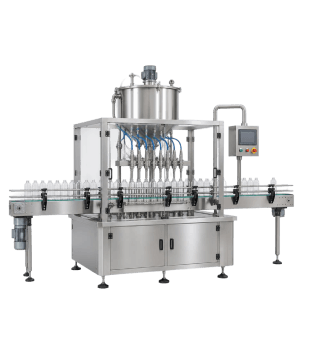
Picking a filling machine starts with the product, not the machine. How your product flows, the container it enters, and the required output per hour narrow your equipment choices rapidly. Selecting the wrong filling principle invariably leads to fill weight inaccuracies, messy drips, excessive foam, and prolonged downtime during format changeovers.
Below is the exact engineering assessment methodology our senior application team uses before recommending an industrial packaging line. Use this guide to evaluate your production readiness or cross-verify technical specifications from equipment quotes.
1. Fluid Dynamics & Product Rheology Classification
Free-flowing liquids such as edible oils, fruit juices, and chemical solvents behave fundamentally differently from non-Newtonian viscous pastes like cosmetic creams, pharmaceutical gels, and condiments. Viscosity, surface tension, particulate suspension, temperature sensitivity, and aeration risks dictate the exact valve and nozzle engineering required.
Understanding whether your product exhibits shear-thinning (pseudoplastic) or shear-thickening (dilatant) characteristics prevents pump cavitation and dosing inconsistencies under continuous operation.
- •Low-Viscosity Liquids (1 - 100 cP): Focus on anti-drip diving nozzles, bottom-up filling to avoid foaming, and sanitary positive shut-off valves.
- •Medium-Viscosity Emulsions (100 - 5,000 cP): Syrups, lotions, and detergents require rotary valves with positive displacement piston chambers.
- •High-Viscosity Pastes (5,000 - 100,000+ cP): Thick pastes, nut butters, and sealants demand heavy-duty rotary valves and jacketed hoppers with heated wiper agitators.
- •Dry Powders & Granules: Differentiate between free-flowing granules (which suit multi-head weighers) and non-free-flowing powders that require vertical servo auger screws.
2. Deep Dive: Matching the Filling Principle to Your Physical Product
Once fluid rheology is mapped, the optimal mechanical filling mechanism becomes obvious. Standard industrial filling technologies include:
- •Volumetric Piston Fillers (e.g. LPF Series): Deliver certified ±0.5% dosing precision for liquids, lotions, and semi-viscous pastes across 50ml to 5000ml batches.
- •Heavy-Duty Rotary Valve Paste Fillers (e.g. PPF Series): Engineered for chunky pastes containing diced fruits, chili flakes, or viscous nut butters.
- •Servo Auger Filling Systems (e.g. KFC-250): Utilize precision servo drives to meter dry seasonings, milk powders, and pharmaceutical active ingredients without dust plumes.
- •Multi-Head Combination Weighers (e.g. MHW-2000): Feature 10 to 14 high-speed load cell weigh buckets for fragile extruded snacks, confectionery, and dry pasta.
- •Net-Weight & Mass Flow Meter Systems: Deliver certified legal-for-trade dosing for high-value chemical drums and bulk 20L containers without mechanical product contact.
3. Sizing the Machine for Current Capacity & Overall Equipment Effectiveness (OEE)
Throughput is typically specified in bottles, pouches, or containers per minute (BPM/PPM). Sizing machinery strictly for today's volume often creates costly bottlenecks within 12 to 18 months of market expansion.
When calculating required line speed, incorporate an overall equipment effectiveness (OEE) buffer of 15% to 20%. Ensure auxiliary upstream and downstream modules—including unscramblers, induction cappers, tamper-evident sealers, wrap-around labellers, and packing conveyors—are synchronized to handle peak burst rates.
- •Single-Head Semi-Automatic Fillers: 10 - 25 units per minute (ideal for pilot batches and boutique runs).
- •Linear Multi-Nozzle Automatic Fillers (2 to 8 Heads): 30 - 90 units per minute for mid-scale production lines.
- •Rotary Monoblock Filling & Capping Turrets: 100 - 300+ units per minute for high-speed automated beverage and pharmaceutical facilities.
4. Changeovers, Tooling & Clean-In-Place (CIP) Standards
If your factory packs multiple SKU sizes or diverse product formulations on a single line, changeover agility is just as crucial as maximum cycle speed. Tool-less nozzle changeouts, quick-release clamps, and digital recipe recall on PLC touchscreens reduce changeovers from hours to under 15 minutes.
For food, dairy, and pharmaceutical operations, specify 316L sanitary stainless steel contact parts with Ra < 0.8 µm surface finish, tri-clamp sanitary fittings, and Clean-In-Place (CIP) automated spray-ball integration.
5. Upstream & Downstream Line Integration
A filling machine does not operate in isolation. Peak packaging efficiency requires seamless mechanical and electrical handshakes between adjacent line equipment.
- •Bottle Unscrambler / Rotary Infeed Table: Ensures consistent neck-up container feeding without jams.
- •Automatic Capping & Torquing Stations: Spindle or chuck cappers with magnetic clutch torque control prevent loose caps or thread stripping.
- •Induction Foil Sealers: Create airtight hermetic seals for shelf-life extension and tamper evidence.
- •High-Precision Checkweighers & Rejection Systems: Automatically eject underfilled or overfilled containers downstream with milligram accuracy.
- •Wrap-Around / Front-and-Back Labelling Machines: Synchronized with optical eye-mark sensors for flawless label positioning.
6. Critical Technical Specifications & Compliance Checklist
Before signing off on equipment procurement, cross-examine these essential engineering parameters with your machinery supplier:
- •Material Certifications: Traceable 304/316L stainless steel mill test certificates and FDA/CE compliance certificates.
- •Automation & Electronics: Standardize on internationally serviceable PLC & HMI touchscreens (Siemens, Schneider, Omron, Delta) with remote Ethernet diagnostics.
- •Pneumatic Air Quality: Minimum 6.0 - 8.0 Bar continuous dry pneumatic supply with dual-stage particulate filtration.
- •Safety Engineering: Dual-circuit emergency stop relays, interlocked polycarbonate safety doors, and torque overload clutch disengagement.
7. Preventive Maintenance & Long-Term Spares Management
A packaging machine is an active long-term capital asset running millions of cycles annually. Inquire about the local availability of critical wear components—including piston seals, silicone O-rings, heating elements, pneumatic solenoid valves, and rotary cutters.
PPH Impex provides complete pre-dispatch Factory Acceptance Testing (FAT), on-site line commissioning, comprehensive operator maintenance training, and guaranteed dispatch of genuine spares within 24 to 48 hours.
8. Return on Investment (ROI) & Total Cost of Ownership
When comparing machinery proposals, calculate Total Cost of Ownership (TCO) over a 5-year operating window rather than solely focusing on initial sticker price. Modern high-accuracy fillers rapidly pay for themselves by reducing product giveaway (overfill waste) and minimizing downtime.
For example, saving just 1.5 grams of excess fill per container across an annual volume of 3 million bottles translates into thousands of dollars in preserved raw material profit margin.
Conclusion & Expert Engineering Assistance
To summarize: start with your product rheology, match the proper filling principle, calculate future throughput targets with realistic OEE margins, and insist on tool-less sanitary engineering. If you would like our application engineers to conduct a free sample packaging analysis and equipment sizing review for your facility, contact our team today.

 Expert Assistance
 Quick Response
 Reliable Support